
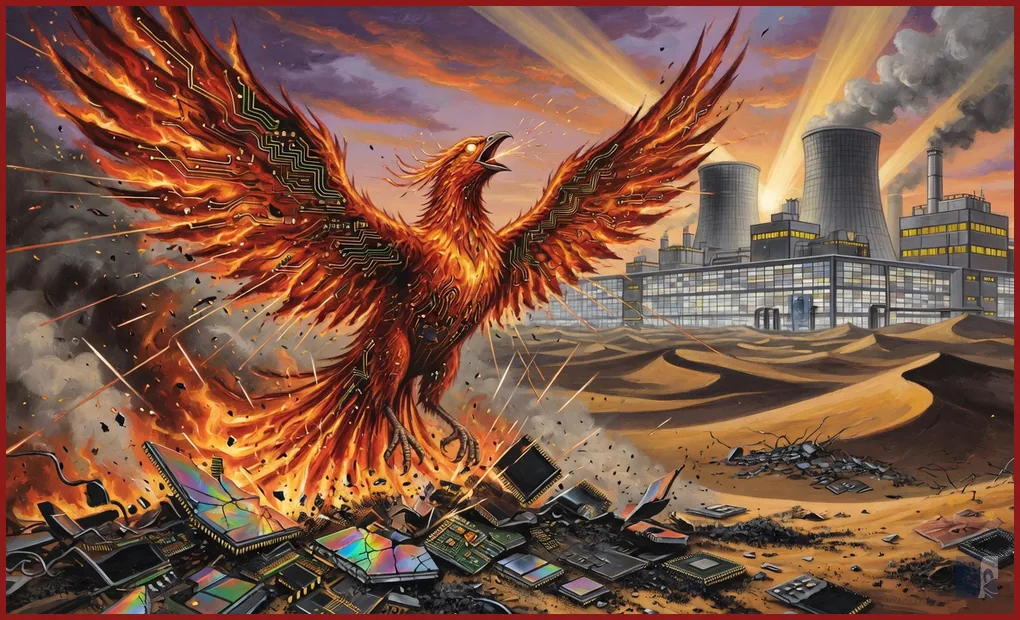
No technology company has died and been reborn as many times as AMD. Founded in 1969 to live in Intel’s shadow, it spent five decades alternating strokes of genius (Athlon, x86-64, Zen) with brushes with disaster — until an engineer named Lisa Su turned a US$ 2 stock into the greatest turnaround in semiconductor history. This is AMD’s story, with dates and scars.
1969: eight men and a second-source plan
In 1º of May, 1969, Jerry Sanders — Fairchild Semiconductor’s most charismatic salesman — founded Advanced Micro Devices with seven colleagues. While Intel, founded by Fairchild alumni Noyce and Moore, was born awash in capital, Sanders struggled to raise money. The initial strategy was humble and smart: be a second source for other companies’ chips, manufacturing their designs with better quality.
1982: the contract that defined everything
When IBM chose the Intel 8088 for its PC, it demanded a second source of supply. The result: in 1982, Intel was forced to license x86 to AMD. The forced marriage soured quickly — in 1987 Intel cut off access to the 386, and the two plunged into eight years of legal warfare ending in 1995 with AMD securing the right to make its own x86 chip designs. Meanwhile, the Am386 (1991) and Am486 sold millions by cloning Intel’s performance for less.
1999–2003: Athlon and the x86-64 masterstroke
With the Athlon (K7, 1999) — a project led by Dirk Meyer, a DEC Alpha veteran — AMD did the unthinkable: it surpassed Intel in performance, and in 2000 reached the first GHz in consumer processor history, days before its rival. The next blow was even bigger: while Intel bet on the incompatible 64-bit Itanium, AMD extended x86 to 64 bits while maintaining full compatibility. The Opteron and Athlon 64 (2003) won so clearly that Intel had to swallow its pride and license AMD64 — to this day, every 64-bit x86 processor on the planet, including Intel’s, runs AMD’s architecture (the x86_64 in your uname -m).
2006–2012: ATI, Bulldozer, and the edge of the abyss
In 2006, AMD paid US$ 5,4 billion for ATI — too much, at the wrong time. In debt, it stumbled on architectures (Barcelona’s delay, the fiasco of Bulldozer in 2011) while Intel got it right with Core. In 2009, it sold its own factories (giving birth to GlobalFoundries) to survive. In 2012, its stock was worth about US$ 2 and analysts were writing obituaries. Ironically, the ATI acquisition would plant the seeds of salvation: APUs secured the contracts for PlayStation 4 and Xbox One (2013) — the cash that kept the lights on.
2014: Lisa Su arrives
In October 2014, engineer Lisa Su (an MIT PhD and IBM veteran) took charge with a plan simple to state and brutal to execute: bet everything on a new architecture. The result was Zen: the Ryzen processors arrived in 2017 with an IPC gain of about 52% over the previous generation, and EPYC invaded servers. In 2019, Zen 2 brought the design of chiplets on TSMC’s 7nm process — modularity that Intel, stuck with its own delayed factories, could not answer.
2020–2026: the complete turnaround
The numbers tell the turnaround story: in 2022 AMD bought Xilinx for US$ 49 billion (the FPGA leader) and surpassed Intel in market capitalization for the first time. The Steam Deck runs an AMD APU under Linux; PS5 and Xbox Series remain on the red team; and the MI300X (2023) put the company in the AI accelerator race — a difficult fight, as we analyzed in the post AMD vs NVIDIA and the CUDA moat: the hardware wins on paper, but its rival’s software still dictates the market.
AMD and Linux: best friends
While NVIDIA has historically clashed with the kernel, AMD took the opposite path: the amdgpu driver is open source and lives inside the kernel (it is routinely the largest block of code in each release, as in 7.3), Mesa/RADV delivers top-tier Vulkan, and ROCm is open. The result: for Linux gaming — from Steam Deck to desktop — the community’s default recommendation is a red-team card.
Timeline
- 1º/May/1969 — Jerry Sanders and seven Fairchild alumni found AMD
- 1982 — IBM forces Intel to license x86 to AMD
- 1987–1995 — Legal war with Intel; AMD wins the right to design its own x86
- 1991 — Am386 sells millions
- 1999 — Athlon (K7) surpasses Intel in performance
- 2000 — First consumer processor at 1 GHz
- 2003 — Opteron/Athlon 64: x86-64 (AMD64) is born, later adopted by Intel itself
- 2006 — ATI acquisition for US$ 5,4 billion
- 2009 — Sells its factories; GlobalFoundries is born
- 2011 — Bulldozer fiasco
- 2012 — Stock at ~US$ 2; near bankruptcy
- 2013 — APUs in PS4 and Xbox One keep cash flowing
- 2014 — Lisa Su takes over as CEO
- 2017 — Ryzen (Zen) and EPYC: the comeback
- 2019 — Zen 2: 7nm chiplets at TSMC
- 2022 — Xilinx acquisition (US$ 49 billion); surpasses Intel in market capitalization
- 2023 — MI300X enters the AI race
- 2025+ — Zen 5/6 and the battle for the AI datacenter
The moral of AMD’s story fits into one admin saying: redundancy matters — the entire industry benefited from having a second x86 source competing on price and innovation. Complete the series with the NVIDIA history and Intel’s history.