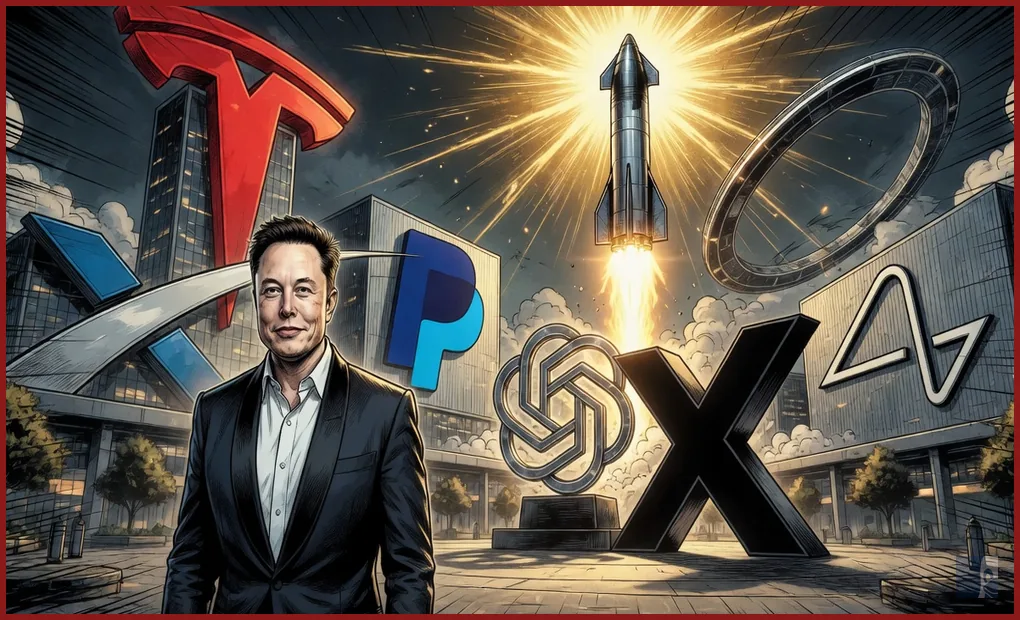
Few technology figures polarize as much as Elon Reeve Musk (Pretoria, 28 June 1971). A visionary of reusable rockets and electric cars to some; a volatile manager and owner-operator of a conglomerate (Tesla, SpaceX/SpaceXAI, Neuralink, X) to others. Before that he slept on an office floor, lost the PayPal CEO job on a plane and came within two days of bankruptcy at Christmas 2008. This text starts from the documentary The Story of Elon Musk (SunnyV2) and fills in what the video cannot fit: Tesla was not founded by him, the Falcon 9 that returns, the brain chip, Grok, the US$ 1,77 trillion IPO in 2026 — and Linux in the middle of the fight.
Pretoria, 1971: books, beatings and Blastar
Son of Maye (a Canadian model and dietitian) and Errol (a South African electromechanical engineer). An introspective child: up to ten hours a day with encyclopedias and science fiction — Asimov (Foundation), Adams (The Hitchhiker’s Guide to the Galaxy). The phrase “the answer is 42” and the idea of a multiplanetary civilization did not originate in a SpaceX pitch deck; they came from the bookshelf.
At school he was subjected to severe violence. In one episode, he was pushed down a flight of stairs and beaten until unconscious — weeks in the hospital. At 10 he got a Commodore VIC-20, learned BASIC from the manual and at 12 sold the space game Blastar for US$ 500 to the South African magazine PC and Office Technology. Citizenship: South Africa, Canada (through his mother) and, later, the United States.
America: Zip2 and the office couch
At 17 he left South Africa — conscription under apartheid and the pull of the Valley. Queen’s University in Ontario, then the University of Pennsylvania: physics and economics. Stanford accepted him into a PhD in applied physics and materials science; on the second day he dropped out to avoid missing the commercial web (1995).
Netscape did not hire him. With his brother Kimbal he started Zip2: online guides and maps for newspapers (New York Times, Chicago Tribune). Without money for both a home and an office, he rented the office, slept on the couch, showered at the YMCA and programmed the server late at night. In February 1999 Compaq bought Zip2 for US$ 307 million in cash. Musk, 27, walked away with about US$ 22 million.
X.com, the coup on the plane and the PayPal mafia
He reinvested US$ 12 million in X.com — digital banking and payment by email. In 2000 it merged with Confinity (Peter Thiel, Max Levchin), owner of the PayPal product. The technical fight was Linux versus Windows NT: Musk wanted to migrate the Unix/Linux infrastructure to NT; Levchin’s team revolted. Linux won that one — PayPal stayed on Unix. (The name X.com he buys back two decades later, for Twitter.)
X.com (Musk)  ──fusão 2000──  Confinity (Thiel / Levchin)
                         │
                         ▼
                    PayPal Inc. (2001)
                         │
              eBay, 2002 — US$ 1,5 bilhão
In October 2000, on a honeymoon flight, the board removed him as CEO and installed Thiel. Musk remained the largest individual shareholder. In 2002 eBay paid US$ 1,5 billion; after taxes, about US$ 180 million. The “PayPal Mafia” that emerged — Thiel, Levchin, Reid Hoffman, Keith Rabois, David Sacks — founded or funded LinkedIn, YouTube, Yelp, Palantir, Affirm. Musk was the one who bet the entire check on rockets and cars.
2008: three rockets, a Roadster and Christmas Eve
The money went into two capital-hungry sectors: US$ 100 million in SpaceX (2002) and US$ 70 million in Tesla (2004). Christmas 2008 almost closed both:
- The first three Falcon 1 rockets failed. There was cash for one fourth flight.
- Tesla’s Roadster went over budget in the middle of the credit crisis.
- His marriage to Justine Wilson ended in the tabloids.
- Without personal liquidity, he asked friends for money for everyday bills and had to close US$ 20 million on Christmas Eve for Tesla payroll.
28 set 2008  Falcon 1 voo 4 alcança órbita
23 dez 2008  NASA assina CRS — US$ 1,6 bi com a SpaceX
véspera Natal  rodada de emergência da Tesla fecha a horas do colapso
Tesla: he did not found it — and still became CEO
Tesla Motors was born in 2003 with Martin Eberhard and Marc Tarpenning. Musk led the Series A in 2004, became chairman and, in October 2008, CEO — in the worst possible month. The 2009 legal fight over who is a “founder” ended with all four (including JB Straubel and Ian Wright) recognized on the site; in practice the name of the brand is his.
The Model S (2012) broke the skepticism of Detroit and Germany. Model 3 and Model Y became global volume sellers. The Supercharger network is the moat gas stations did not copy in time. FSD (Full Self-Driving) runs on Linux in the car, with custom chips (HW3/HW4) and a fleet collecting video — the same kind of data that trains large models. Optimus is the humanoid robot; Cybertruck, the stainless-steel pickup the press hated and a slice of fans bought. SolarCity became Tesla Energy: Megapack stabilizes grids (and, in 2024–2025, SpaceX itself and xAI bought hundreds of millions in Tesla batteries).
Tesla’s internal “algorithm”, which Musk repeats in interviews: question every requirement; delete whatever part you can; simplify; accelerate the cycle; only then automate. Automating the wrong process is the most expensive way to fail.
SpaceX: the rocket that returns
The trick was not “going to Mars in PowerPoint”. It was rejecting disposable rockets. On 21 December 2015 the Falcon 9 first stage landed upright at Cape Canaveral. In 2018 Falcon Heavy debuted with a red Tesla Roadster in heliocentric orbit and the Starman mannequin at the wheel. In 2020 Crew Dragon (Demo-2) took NASA astronauts to the ISS — the first private company to do so.
Starlink became the cash engine: thousands of satellites in low orbit, Internet where cables do not reach, and a wartime product (Ukraine, 2022) that Musk began treating as geopolitical leverage. Starship, stainless steel, two stages, is the bet on full reusability for satellites, the Moon (Artemis) and Mars. Test flights (IFT) explode in public — the method is the same as in 2008: fail cheaply, iterate, do not hide the fire.
Vertical integration: ~85% in-house. The same first principle of the rocket with 2% in raw materials.
Neuralink: 1.024 electrodes and patient P1
Founded in 2016. The N1 (“Link”) implant is coin-sized, wireless, 64 threads, 1.024 electrodes in the motor cortex, implanted by a robot. In January 2024 the first human, Noland Arbaugh (quadriplegic after a diving accident), received the chip in Phoenix. Weeks later he was moving the cursor and playing chess through the intention to move. About 85% of the threads retracted from the tissue — the signal dropped, then stabilized. Other patients followed; Musk’s rhetoric ranges from “restoring autonomy to people with paralysis” to “an interface with AI so the species does not fall behind”. BCI did not originate at Neuralink (BrainGate has existed for years); what it sold was the wireless + robot + stage package.
OpenAI, Grok and the US$ 1,77 trillion IPO
Musk cofounded OpenAI in 2015 as a nonprofit lab. He left the board in 2018 after disagreeing with its direction (and later suing). In July 2023 he opened xAI. The chatbot is Grok; the cluster is Colossus in Memphis (hundreds of thousands of NVIDIA GPUs). Weights for some models were released for research — the same territory as Ollama on Linux and the fight GPU vs TPU.
February 2026: SpaceX absorbs xAI (and with it X). Brand SpaceXAI. June 2026: IPO on Nasdaq, ticker SPCX, about US$ 75 billion raised, valuation around US$ 1,77 trillion — the largest IPO in history. The S-1 made explicit what the rocket now finances: compute, including talk of data centers in orbit. Tesla had US$ 2 billion in xAI; the merger turned that into SpaceX stock. The conglomerate is one balance sheet with three engines: launches, satellites and language models.
X, Hyperloop and the rest of the shelf
In 2022 Musk bought Twitter for US$ 44 billion, laid off staff en masse, renamed it X and tried the “everything app”. In 2013 he published the white paper for Hyperloop — vacuum tube, levitating capsule — and left the world to copy it; he did not build the line. The Boring Company (2016) became a Las Vegas tunnel, not Hyperloop. That is the shelf: a core (SpaceX + Tesla + xAI) and satellites that sometimes pay the rent on attention.
First principles, not analogy
Inherited from physics: break things down to physical truth, not to “it has always been this way”. Expensive rocket? Raw material cost. Electric car “does not scale”? Battery and production physics. Tesla’s algorithm is the operational version: question, delete, simplify, accelerate, automate last. It is the same refusal to accept industry pricing that the hobby kernel brought to proprietary UNIX — different ground, same stubbornness.
The map, updated in 2026
- Zip2 (1995) — web maps. Compaq, US$ 307 million.
- X.com / PayPal (1999) — payments. eBay, US$ 1,5 billion. Linux won the stack fight.
- SpaceX (2002) — landing Falcon, Crew Dragon, Starlink, Starship. SPCX IPO, 2026.
- Tesla (joined 2004; CEO 2008) — S/3/Y, FSD on Linux in the car, Energy, Optimus.
- OpenAI (2015, cofounder) — left in 2018.
- Neuralink (2016) — N1; first human in 2024 (Noland Arbaugh).
- The Boring Company (2016) — tunnel in Las Vegas.
- X (Twitter, 2022) — US$ 44 billion, cuts, rebrand.
- xAI → SpaceXAI (2023 / Feb 2026) — Grok, Colossus; absorbed by SpaceX.
Timeline
- 28/Jun/1971 — Born in Pretoria, South Africa
- 1983 — At 12, sells the game Blastar for US$ 500
- 1995 — Drops out of the Stanford PhD; founds Zip2 with his brother Kimbal
- Feb/1999 — Compaq buys Zip2 (US$ 307 million); founds X.com
- 2000 — Merger with Confinity (PayPal); removed as CEO
- 2002 — eBay buys PayPal (US$ 1,5 billion); founds SpaceX
- 2004 — Leads Tesla’s Series A and becomes chairman
- Oct/2008 — Takes over as Tesla CEO; Falcon 1 reaches orbit
- 2012 — Tesla Model S breaks industry skepticism
- 2015 — Cofounds OpenAI; first Falcon 9 landing (21/Dec)
- 2016 — Founds Neuralink and The Boring Company
- 2018 — Leaves OpenAI; Falcon Heavy debut
- 2020 — Crew Dragon takes NASA astronauts to the ISS
- 2022 — Buys Twitter (US$ 44 billion) and renames it X
- 2023 — Founds xAI (Grok chatbot)
- Jan/2024 — First human receives the Neuralink implant
- Feb/2026 — SpaceX absorbs xAI and X (SpaceXAI brand)
- Jun/2026 — Nasdaq IPO (SPCX): ~US$ 1,77 trillion, the largest in history
Light and shadow
The biography does not fit into a slogan. Impossible schedules and betting his own payroll forced aerospace and automotive industries to advance decades in a few years. Management under pressure, mass layoffs, lawsuits, public jokes and a year in Washington (DOGE, 2025) generate the other side of the headline. PayPal on Linux, Autopilot on Linux, Grok that you can try locally — that is what remains useful in the terminal, regardless of whether you like the owner.
The impact did not come from a safe path. It came from refusing failure as a final option — and surviving Christmas 2008 with a rocket that finally reached orbit.
Starting documentary: SunnyV2 — The Story of Elon Musk.