
On 25 August 1991, a 21-year-old student in Helsinki told the comp.os.minix that was building “a (free) operating system (just a hobby, won't be big and professional like gnu)”. Thirty-five years later, the kernel born from that hobby runs most of the internet's servers, every TOP500 supercomputer, Android, and the cloud. Linus Benedict Torvalds is still the one who opens and closes each merge window — now in the 7.x series, from home, in Portland, Oregon.
1969: Helsinki, VIC-20 and Swedish from Finland
Linus was born on December 28, 1969, in Helsinki, into a Swedish-speaking Finnish family. His parents, Nils and Anna Torvalds, were journalists — Nils would later become a member of the European Parliament. One grandfather, Ole Torvalds, was a poet; the other, Leo Törnqvist, was a statistician at the University of Helsinki. It was on a Commodore VIC-20 that the grandson started programming, in 1981, at the age of 11: first BASIC, then machine code written directly for the 6502 CPU. Then came a Sinclair QL.
In 1988 he enrolled in Computer Science at the University of Helsinki. In the summer of 1989 he interrupted his studies for mandatory military service: 11 months in the officer training program of the Nyland Brigade, of the Finnish Navy, from which he emerged as a second lieutenant.
1991: the 386, MINIX and “just a hobby”
Back at the university in 1990, Linus had his first contact with Unix and read Operating Systems: Design and Implementation, by Andrew Tanenbaum, the MINIX book. In January of 5 1991 he bought a 386 IBM-compatible PC; shortly afterward the MINIX copy arrived. He started writing, in 80386 assembly, a task switcher and a terminal driver — a personal project, outside of any coursework.
The post of August 25 on Usenet became famous for its tone:
I'm doing a (free) operating system (just a hobby, won't be big
and professional like gnu) for 386(486) AT clones.
The system was almost called Freax (free + freak + x). Ari Lemmke, who hosted the sources on the university's FTP, created the directory linux — and the name stuck. 0.01 was released in September of 1991; 0.02, announced on 5 October, was already running bash and gcc. The tarballs for those releases remain in the historical directory at kernel.org.
1992–1994: GPL, Tanenbaum and Linux 1.0
The original license prohibited distributing the kernel for money. In the release notes for 0.12, at the beginning of 1992, Linus announced the switch to the GNU license, effective February 1st. It was the decision that allowed distributions — Slackware, Debian, Red Hat — to package and sell the system.
Around the same time, in January 1992, Tanenbaum opened on comp.os.minix the thread “LINUX is obsolete”: microkernel versus monolithic kernel. The debate showed the style that would accompany Linus for decades — direct, sometimes blunt, always technical. Linux wasn't GNU, and GNU had no ready kernel; together they became the system the industry calls “Linux” and purists call GNU/Linux. In 14 March 1994 Linux 1.0 was released. The longer story is in Linux turns 35 and in UNIX — the origin.
At the end of 1993, while teaching practical introductory computing lab classes, Linus asked the students to send him a test email. Tove Monni — six-time Finnish champion of karate — replied by asking him out. They later married and have three daughters, two born in the United States.
1997–2007: Transmeta, OSDL and the Linux Foundation
In February 1997, Linus moved to California, to Transmeta — the Crusoe CPU, code morphing, low power consumption. He stayed until June 2003 and moved to the Open Source Development Labs (OSDL), which paid him to work only on the kernel. In 2004 the family moved to the Portland, Oregon area, near OSDL's headquarters. In January 2007 OSDL merged with the Free Standards Group and became the Linux Foundation, which to this day maintains him as a fellow. He became an American citizen in 2010.
In 2001 he left Just for Fun: The Story of an Accidental Revolutionary, written with David Diamond. In 2012 he received the Millennium Technology Prize, shared with the Japanese Shinya Yamanaka.
2005: Git, when BitKeeper was over
Since 2002 the kernel had been using BitKeeper, a proprietary system from BitMover, by Larry McVoy, under a free license. The relationship broke down when Andrew Tridgell (of Samba) reverse-engineered the protocol, and BitMover withdrew the free license in April of 2005. Linus started writing the replacement at the beginning of April; the first Git commit — “the information manager from hell” — is from April 7, 2005. Tree snapshots, content addressed by hash, truly distributed. Within a few weeks the kernel was already versioned in it.
In July of 2005 Linus handed over Git maintenance to Junio Hamano, who remains in the role. The full story is at The history of Git, and the hands-on tutorial at Git made simple and fast. Without Git there would be no GitHub, GitLab or the pull request flow that the rest of the industry copied.
2011: the programmer who also writes diving software
One detail often missed by people who only know the biting quotes from the mailing list: Linux and Git aren't the only programs he wrote because he disliked what was available. In 2011, dissatisfied with the available dive logs, Linus started Subsurface — a free dive log, later handed over to Dirk Hohndel. It's the same pattern as the other two times: a personal tool that became a community project.
2018: the code of conduct and the pause
For two decades the kernel mailing list coexisted with replies ranging from sarcasm to insult — the middle finger to NVIDIA in a talk at Aalto University, in 2012, became a permanent meme. In 16 September 2018, in the announcement of 4.19-rc4, Linus publicly apologized for his own behavior, announced a break, and the kernel adopted a code of conduct. He returned in October, more restrained. Those who follow the list agree the tone changed; those who disagree with him technically still hear the same “no”.
2026: how he maintains the kernel
The model hasn't essentially changed: a network of subsystem maintainers pushing pull requests upward; two weeks of merge window; usually seven or eight release candidates; Linus with the final word. He describes his own work less as “writing code” and more as reading justifications, judging architectural fit, and deciding what goes into mainline.
Linux 7.0 shipped in 12 April 2026, with about 42 million lines counting all files in the tarball. It was the version that officially ended the “Rust experiment”, started in 6.1 — the conclusion was reached at the Maintainers Summit of 2025. 7.1 shipped in 14 June and 7.2 in 16 August; as this text is being revised, 7.3 is in release candidate. ARM, RISC-V, scheduling, Rust GPU drivers like Nova, and the flood of LLM-assisted patches — everything goes through the roughly nine-week cycle that Linus closes from home in Portland.
Timeline
- 28 December 1969 — born in Helsinki, into a Swedish-speaking Finnish family.
- 1981 — at 11 years old, begins programming on a Commodore VIC-20.
- 1988 — enrolls in Computer Science at the University of Helsinki.
- 1989–1990 — military service in the Nyland Brigade of the Finnish Navy; leaves as second lieutenant.
- 5 January 1991 — buys a PC 386; then receives the MINIX and starts the task switcher in assembly.
- 25 August 1991 — the post on
comp.os.minix: “just a hobby”. - September 1991 — the 0.01 is released; in 5 October, the 0.02 is already running
bashandgcc. - January 1992 — Tanenbaum–Torvalds debate (“LINUX is obsolete”).
- February 1, 1992 — with the 0.12, the kernel moves to the GNU license.
- End of 1993 — meets Tove Monni, a student in the lab classes he was teaching.
- 14 March 1994 — Linux 1.0.
- February 1997 — moves to California and joins Transmeta.
- 2001 — publication of Just for Fun, written with David Diamond.
- June 2003 — leaves Transmeta for Open Source Development Labs.
- 2004 — moves with his family to the Portland, Oregon area.
- April 2005 — the free BitKeeper license ends; in 7 April the first commit of Git. In July, Junio Hamano takes over maintenance.
- January 2007 — OSDL merges with the Free Standards Group and becomes the Linux Foundation.
- 2010 — obtains US citizenship.
- 2011 — starts Subsurface, his dive log.
- 2012 — receives the Millennium Technology Prize, shared with Shinya Yamanaka.
- 16 September 2018 — apologizes on the mailing list, takes a break, and the kernel adopts a code of conduct.
- December 2022 — Linux 6.1 accepts the Rust infrastructure as an experiment.
- 12 April 2026 — Linux 7.0, which declares the Rust experiment ended.
- 16 August 2026 — Linux 7.2.
Wrap-up
Two artifacts. The kernel: Android, AWS, Azure, Google, supercomputers, routers, TVs, whatever desktop you want. Git: practically every software repository on the planet. Neither has been “a one-person project” for decades — and both were born from the same frustration of someone who didn't like the tools they had.
More context on this blog: Open Source Pioneers, the history of operating systems, Ian Murdock and Debian, Carlos Morimoto and Kurumin and the second language he let into the kernel, in The history of the Rust language. And the biography of Elon Musk — which also started on a VIC-20, with a different destination.
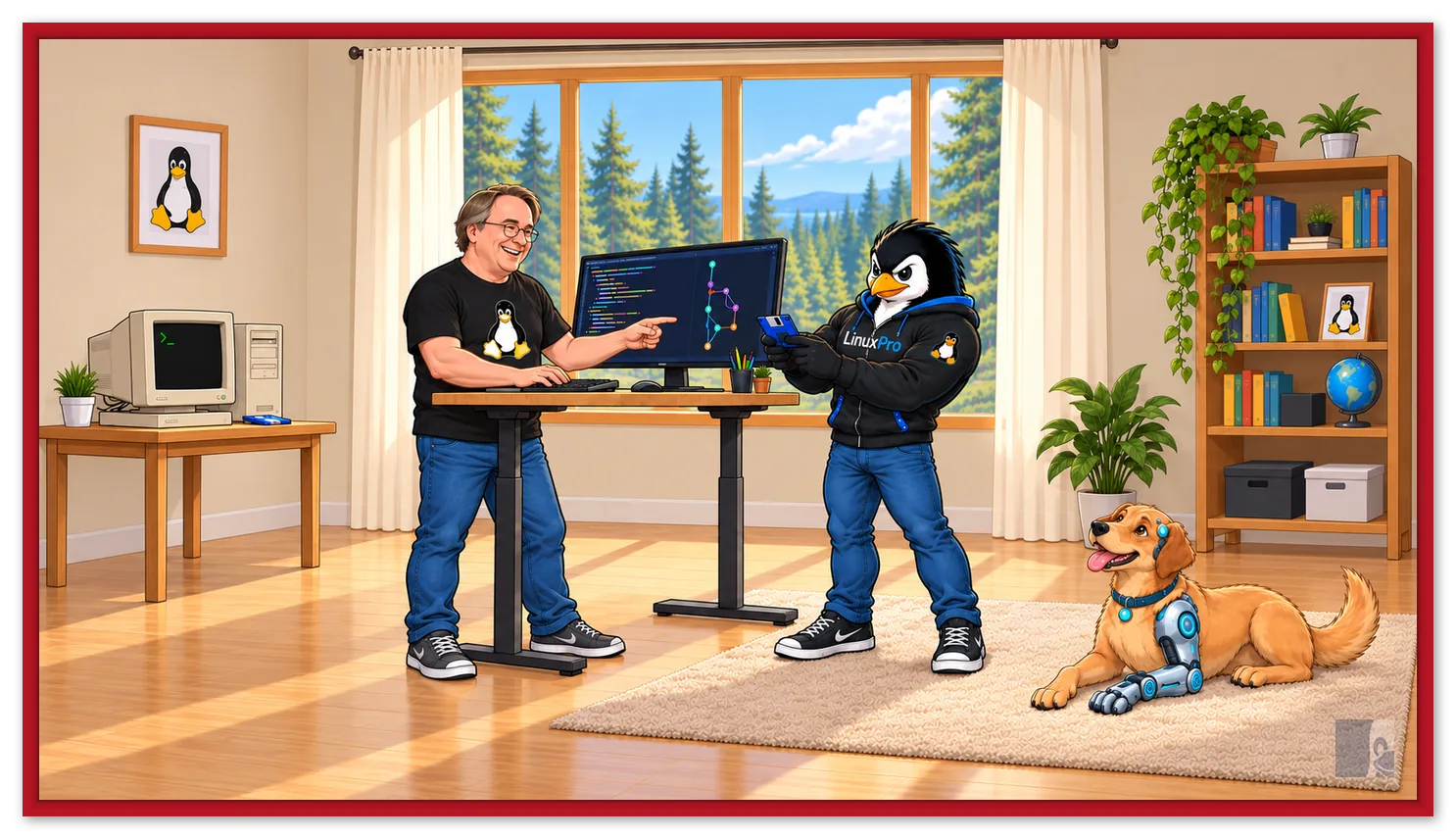
Cover illustration drawn from photographs of Linus Torvalds available on Wikimedia Commons: LinuxCon Europe Linus Torvalds 03 (cropped), photo by Krd, crop by Von Sprat, licensed under CC BY-SA 4.0, and LC3Beijing2018 (cropped), by Raysonho, in the public domain (CC0).

