

In Brazil in the years after 2000, putting Linux on a desktop still meant dealing with partitioning, LILO, and English-language forums. Carlos Eduardo Morimoto da Silva — the Guia do Hardware guy — decided to do the opposite: a Portuguese-language live CD with KDE, “magic icons” that installed everything with one click, and small enough to fit on a pocket mini-CD. He named it Kurumin, from the Tupi-Guarani curumim, “boy.” For a few years it was the country's most talked-about distribution. In January 2008 he pulled the plug himself. The legacy remained in books, Hardware.com.br, and an entire generation that installed Linux for the first time without fear.
From BASIC to Guia do Hardware
Morimoto started early and on his own. He programmed in BASIC at seven, repaired PCs at thirteen, and published his first book — Hardware PC, through Book Express — at seventeen. A systems analysis graduate, he always described himself as self-taught. Linux entered his life in 1998, on a CD of Conectiva 2.0 Marumbi, the Brazilian distribution of the time — so his first contact was already with a homegrown Linux, not an imported hobby.
In 1999 he founded Guia do Hardware (later Hardware.com.br): articles, a forum, and e-books, all in clear Portuguese. In 2001 he released Entendendo e Dominando o Linux, for free online, applying the formula Kurumin would inherit — accessible text, step by step, without requiring readers to already be systems administrators. In 2005 he opened GDH Press; Hardware, o Guia Definitivo sold thousands of copies, and titles such as Redes, Servidores Linux and Kurumin 7, Guia Prático still circulate at hardware.com.br/livros. Unsurprisingly, BR-Linux named him National Free Software Community Personality for five consecutive years, from 2003 to 2007.
14 January 2003: the CD that rescued Windows
Kurumin was not born with the ambition of becoming “Brazil's distro.” It began in late December 2002 to solve an annoying problem: the Guia do Hardware CD-ROM — containing books and the offline website — was useless when a customer's Windows refused to boot. The solution was a small, easy Portuguese-language live CD to consult that content on a broken PC. The first test version came out on 14 January 2003.
Technically, the base was Knoppix — the source of Klaus Knopper's excellent hardware detection — with pieces of Kanotix and Debian packages on top, all on the KDE desktop. The “K” in the name serves both: Knoppix and KDE. The rest is curumim. The website announcement attracted people, Morimoto took the project forward, and the result exceeded every expectation: DistroWatch even listed it as Brazil's most popular distribution, the government of Paraná adopted it, and a 2010 interview mentions somewhere between one and two million downloads — a figure from the time, unaudited, but indicative of the scale of the conversation.
What Kurumin got right
Its success was not luck: it was a handful of sound product decisions, almost all years ahead of the rest of the Linux world.
- A real live CD — insert the disc, reboot, and Linux was running, without formatting anything. The early versions fit on an 80 mm mini-CD, which literally fit in a wallet.
- Hardware detection inherited from Knoppix: sound card, modem, and network working immediately — at a time when that was the exception.
- Magic icons — Kommander scripts on top of bash: one click installed what Windows users actually wanted (NVIDIA drivers, OpenOffice, codecs). The message was direct: “you do not need to learn
apt-get“. - Graphical installer for those willing to install it on the hard drive.
- Everything in pt-BR, even the GRUB menu.
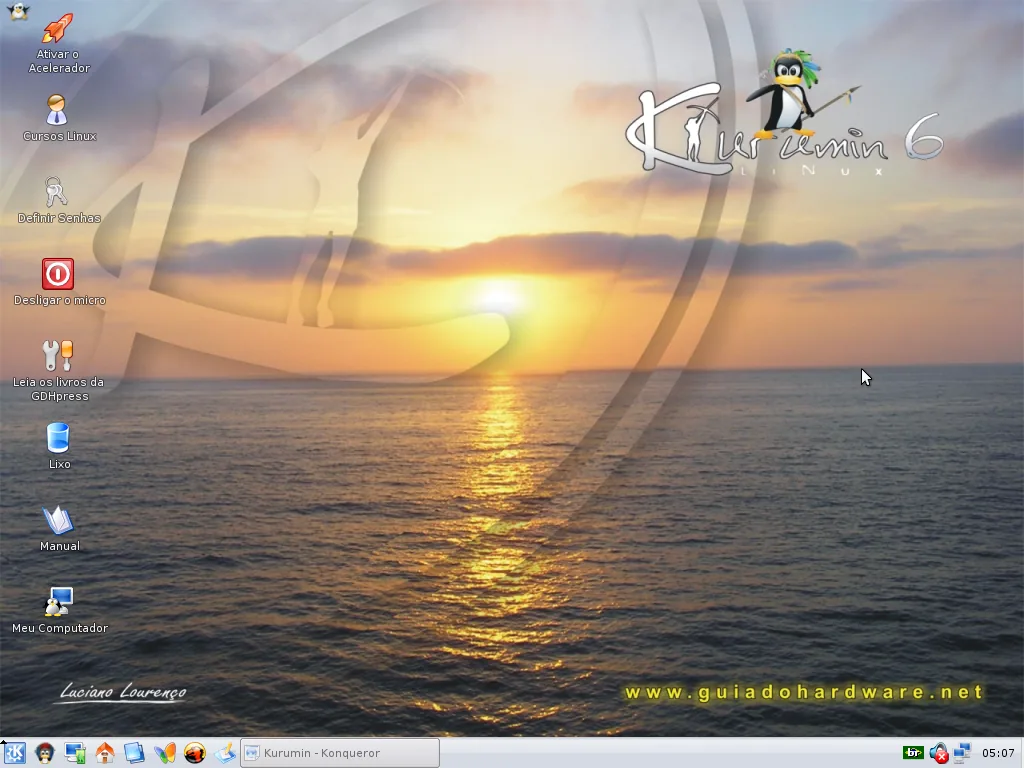
Kurumin 6.0: “Turn off the PC”, “Read the GDHpress books” and the address of Guia do Hardware on the wallpaper itself. Screenshot by JorgePeixoto, Wikimedia Commons, CC BY-SA 3.0.

The mascot was a Tux wearing a headdress, art by community contributors; the Kurumin 6 wallpaper, above, bears the signature of Luciano Lourenço. The symbol — the “K” with the archer silhouette — became as recognizable as the name. The version 7.0, from 2007, was the peak: mature KDE, a dedicated guidebook, and a kernel still old enough to recognize winmodems. The development cycle was so fast that, as Augusto Campos joked while testing 1.4 beta on BR-Linux in May 2003, CDs sent by mail were already outdated on arrival. Kurumin was not the first Brazilian distribution — Conectiva came before it — but it was the one that made a Linux desktop seem possible in the living room, on a cousin's PC, and in a school lab.
2008: the end, and the “disastrous attempt at continuation”
In January 2008, Morimoto discontinued the project. The official statement was honest and blunt: successful adoption, but a failure to attract active developers, constant demands for new features, and a kernel too old for machines reaching the market. The ISOs stayed online for old PCs, and the book Kurumin 7 was repurposed as a general Debian/KDE guide.
Between March 2008 and January 2009, Kurumin NG appeared — led by Leandro Soares, creator of Kalango, now on a Kubuntu base — attempting to succeed the original. A back-and-forth of announcements and reversals followed until Morimoto cut ties. The 7.0r3 page itself recorded the epitaph: “disastrous attempt at continuation”. There was never a Kurumin 8.
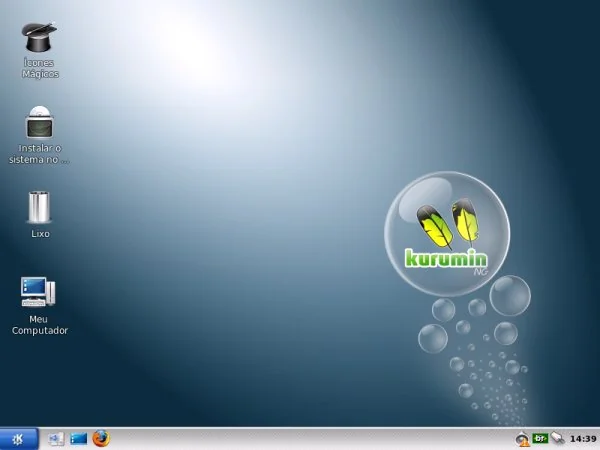
Kurumin NG, already on Kubuntu: the “Magic Icons” were still there, now in a single shortcut. Screenshot from Wikimedia Commons, CC BY-SA 3.0.

2014: Guia do Hardware closes its chapter
On 28 February 2014, Morimoto published “The end of an era”: the portal's computing content had aged, and the team would move to another project. Contributors respectfully related the rest — he left public IT life to dedicate himself to the Hare Krishna movement (as Caitanya Chandra Dasa), in Rio Grande do Sul. The books remain on sale, the forum became a historical archive, and there was never a “return of Kurumin.” The Infomedia interview (Guarulhos, 2010) remains the best portrait of the author discussing his own project:
Timeline
- 1998 — Morimoto discovers Linux on a Conectiva 2.0 Marumbi CD
- 1999 — Founding of Guia do Hardware
- 2001 — Entendendo e Dominando o Linux released free online
- dez/2002 — The idea for Kurumin is born (to consult the Guia CD on a broken PC)
- 14/jan/2003 — First test version of Kurumin
- 2003–2007 — Five consecutive wins as National Free Software Community Personality (BR-Linux)
- 2005 — GDH Press opens
- 2007 — Kurumin 7.0: the project's peak
- jan/2008 — Morimoto discontinues Kurumin (last version: 7.0r3)
- 2008–2009 — Kurumin NG attempts to succeed it and fails
- 28/fev/2014 — “The end of an era”: Guia do Hardware content ends
Running Kurumin today
The project ended, but the ISOs survived. The Internet Archive stores Kurumin 5.0 and 6.0 images, marked as public domain, and they still boot — in a virtual machine, the sensible way to visit a 2005 live CD:
sudo apt install qemu-system-x86

wget https://archive.org/download/kurumin-6.0/kurumin-6.0.iso

qemu-system-i386 -m 512 -boot d -cdrom kurumin-6.0.iso -vga std
Three details explain this command. Kurumin is i386, 32 bits, so the binary is qemu-system-i386 and not x86_64. The 512 MB of RAM is a luxury for a distro that ran in 128. And -vga std prevents the old X server from getting lost trying to negotiate a video driver that did not exist in 2005.
Others preserve the project's memory outside the Archive too: the Memorial Kurumin Linux — “the little Indigenous boy who democratized Linux in Brazil” — gathers the distribution's collection on a dedicated website.
It is worth more as archaeology than nostalgia: it boots straight into Portuguese KDE, magic icons in place, without installing anything or touching your disk. In two minutes you can understand why it seemed magical then — and why today, with Ubuntu live USBs doing the same on modern hardware, it would no longer be missed. kurumin-ng, the continuation that did not take off, is there too, for anyone wanting to see the epilogue.
Wrap-up
Ubuntu, Debian, and live USBs eliminated the need for a national Knoppix. But the “Morimoto way” — clear text, a bootable ISO, zero mystery — is exactly what every “beginner-friendly” distribution still copies today. The Debian lineage underpinning it is told in The history of Ian Murdock; the kernel, in The history of Linus Torvalds and in Linux turns 35. The Brazilian desktop of that era — the missing chapter — is here.
Memorial: kuruminlinux.com.br · Preserved ISOs: Kurumin 6.0 and Kurumin 5.0 on the Internet Archive · books: hardware.com.br/livros.
Kurumin 7.0r3, 2008. Guia do Hardware, 2014. The curumim did not return, but those who learned Linux on a yellow mini-CD never forgot the name.