
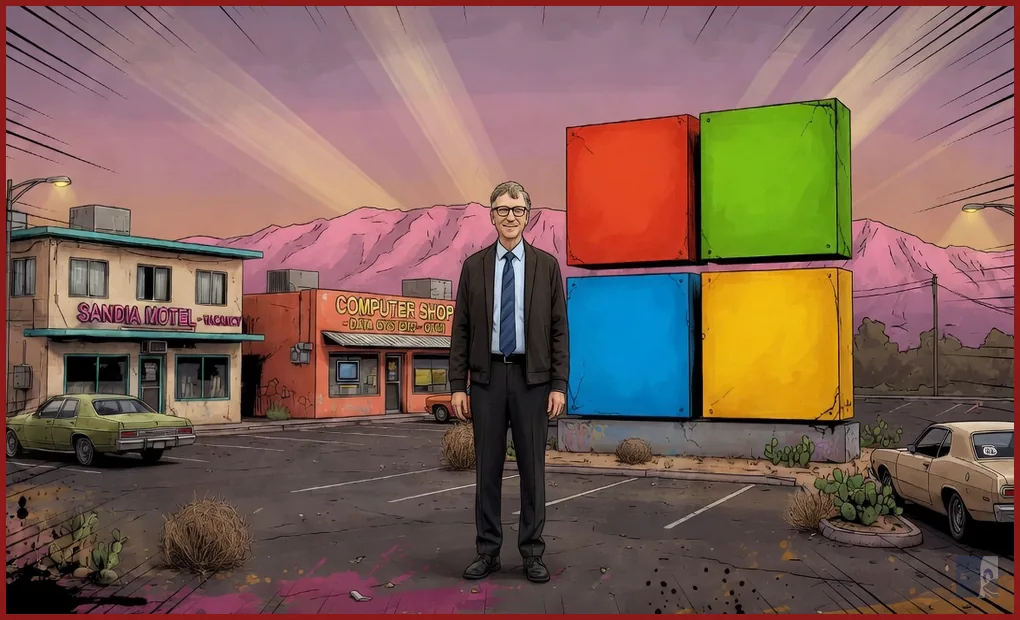
On 4 April 1975, in a room at the Sundowner Hotel on Route 66, in Albuquerque, William Henry Gates III and Paul Allen formalized “Micro-Soft”: 60% for Gates, 40% for Allen, and a BASIC for the Altair 8800 computer as the only product. Fifty years later, Microsoft is worth trillions, runs more Linux than Windows on its own Azure, and Gates is devoted to giving away almost everything he has left by 2045. This is the story of the man who taught the industry to charge for software — and saw his own company, decades later, embrace the open source it once tried to contain.
Lakeside, the teletype and Traf-O-Data
Gates was born in Seattle on 28 October 1955, the son of a lawyer and a foundation board member. At Lakeside School, the mothers’ club bought time on a teletype connected to a GE computer — and Gates, with Paul Allen (three years older), began spending nights programming on punched paper tape. In 1972, the two built Traf-O-Data, a device that read traffic-counting tapes with an Intel 8008 processor: the dress rehearsal for what was to come. Gates entered Harvard in 1973, but would never graduate.
The turning point was the January 1975 cover of Popular Electronics, featuring the Altair 8800 from Ed Roberts’s MITS, in Albuquerque. Allen saw it at the newsstand; Gates called Roberts claiming the two already had a BASIC interpreter ready for the machine. They did not. In eight weeks, they wrote everything on an 8080 processor emulator running on Harvard’s PDP-10. Allen flew to Albuquerque with the tape, typed PRINT 2 + 2 and the machine replied 4. It worked the first time. MITS hired Allen; Gates left Harvard the following summer.
The letter to hobbyists and software as a product
The April 1975 partnership already gave Gates control, which he would later adjust to 64/36 — Allen, the son of a librarian, would note in his autobiography Idea Man that this was the difference when negotiating with a lawyer’s son. The company name, Allen’s idea, combined microcomputer and software.
On 3 February 1976, Gates published the famous “Open Letter to Hobbyists”: Microsoft’s BASIC was being freely copied in computer clubs and, unless someone paid for it, Gates argued, “there will be no good software”. The Homebrew Computer Club community — the same club as Steve Wozniak — received the text as an insult. But in practice it was the founding manifesto of an idea that would define the industry: software is a product to sell, not a favor to return. The company registered its name in New Mexico on 26 November 1976, moved to Bellevue, Washington, on 1º January 1979, and licensed the same BASIC to Commodore, Apple and Radio Shack — the trick was selling the same code to everyone.
IBM, DOS and Windows: the contract that was not exclusive
In 1980, IBM needed an operating system for its new PC. Digital Research, of CP/M, stalled in negotiations. Microsoft then bought 86-DOS from Seattle Computer Products (Tim Paterson’s), adapted it and signed an IBM contract that was nonexclusive. On 12 August 1981, the IBM PC shipped with PC-DOS — but it was clone manufacturers, buying MS-DOS directly from Microsoft, that made the company’s fortune. That “nonexclusive” is the origin of Wintel: volume went to whoever sold the system to the whole market, not whoever built the box.
The Windows 1.0 arrived on 20 November 1985, a graphical interface over DOS inspired by the Macintosh. The IPO, on 13 March 1986, left Gates with about 45% of the company and made him the youngest self-made billionaire of the time. Windows 95, released on 24 August 1995 with the Start button and midnight lines at stores, cemented dominance; Office swallowed the competition in office suites; and Internet Explorer, distributed free inside Windows, would end up in court.
Antitrust, the Halloween Documents and the kernel on the other side
The case United States v. Microsoft began on 18 May 1998, accusing the company of tying Internet Explorer to Windows to kill Netscape. In 2000, Judge Thomas Penfield Jackson even ordered the company split into two — a decision softened on appeal. The 2001 settlement did not split it, but opened APIs and brought years of oversight, as well as a series of heavy fines in Europe.
For readers of this blog, there is a document as foundational as BASIC: in October 1998 the leaked Halloween Documents, internal memos about how to “contain” Linux and open source, were published by Eric Raymond. The response from Silicon Valley and system administrators was Apache, GNU and Linus Torvalds’s kernel — the story is in Linux turns 35. Gates handed the CEO role to Steve Ballmer on 13 January 2000, left day-to-day operations in 2008 and left the board on 13 March 2020. Under Satya Nadella, CEO since 2014, the company reinvented itself: Azure (whose largest workload is Linux), the GitHub acquisition in 2018, VS Code, WSL and open-source .NET. The Microsoft of 2026 is not the one from the 1976 letter — and Gates himself now holds less than 1% of it.
The foundation and the plan to empty the account by 2045
The Bill & Melinda Gates Foundation was born in 2000 from the merger of family foundations, focusing on vaccines, malaria, polio and education. Gates and Warren Buffett created the Giving Pledge in 2010. Melinda left the co-chair position in June 2024 and, in January 2025, the institution became simply the Gates Foundation, with Gates as sole chairman and Mark Suzman in charge. By the end of 2025, it had distributed more than US$ 110 billion in resources, on an endowment in the US$ 90 billion range — to which Gates and Melinda contributed US$ 63,9 billion and Buffett US$ 47,9 billion.
In May 2025, Gates announced he would donate about 99% of what he had left — at the time, some US$ 107 billion — and that the foundation would close its doors at the end of 2045, after spending around US$ 200 billion over twenty years. In July 2026, Buffett stopped his donations to the foundation and redirected around US$ 6 billion to his own children’s foundations, pending a review of Gates’s ties to Jeffrey Epstein. Most of Gates’s fortune, now in the US$ 105 to 111 billion range, is no longer in Microsoft: it is in Cascade Investment, managed by Michael Larson since 1994.
Timeline
- 28/Oct/1955 — Born in Seattle
- 1972 — Traf-O-Data, with Paul Allen (Intel 8008)
- 1973 — Enters Harvard (does not graduate)
- 4/Apr/1975 — Founding of Micro-Soft, in Albuquerque
- 3/Feb/1976 — “Open Letter to Hobbyists”
- 1979 — Move to Bellevue, Washington
- 1980–1981 — Nonexclusive contract with IBM; IBM PC with PC-DOS
- 20/Nov/1985 — Windows 1.0
- 13/Mar/1986 — Microsoft IPO; Gates, the youngest self-made billionaire
- 24/Aug/1995 — Windows 95
- 18/May/1998 — Antitrust case begins; Halloween Documents leak
- 13/Jan/2000 — Ballmer takes over as CEO; foundation is born
- 2008 — Gates leaves Microsoft’s day-to-day operations
- 2010 — Giving Pledge, with Buffett
- 13/Mar/2020 — Leaves Microsoft’s board
- May/2025 — Announces donation of ~99% and foundation closure in 2045
Wrap-up
A boy from Lakeside, a teletype, a BASIC written in eight weeks and a contract that was not exclusive. Gates taught the industry that software comes at a price — and decades later Microsoft itself began publishing code it had once tried to contain. Paul Allen died on 15 October 2018; the remaining partner wants to empty the account by 2045.
That is why this post’s cover is Albuquerque, not Redmond: the motel, the desert and the four squares in the courtyard where MITS sold the Altair. The software that now runs on every desk started there.