
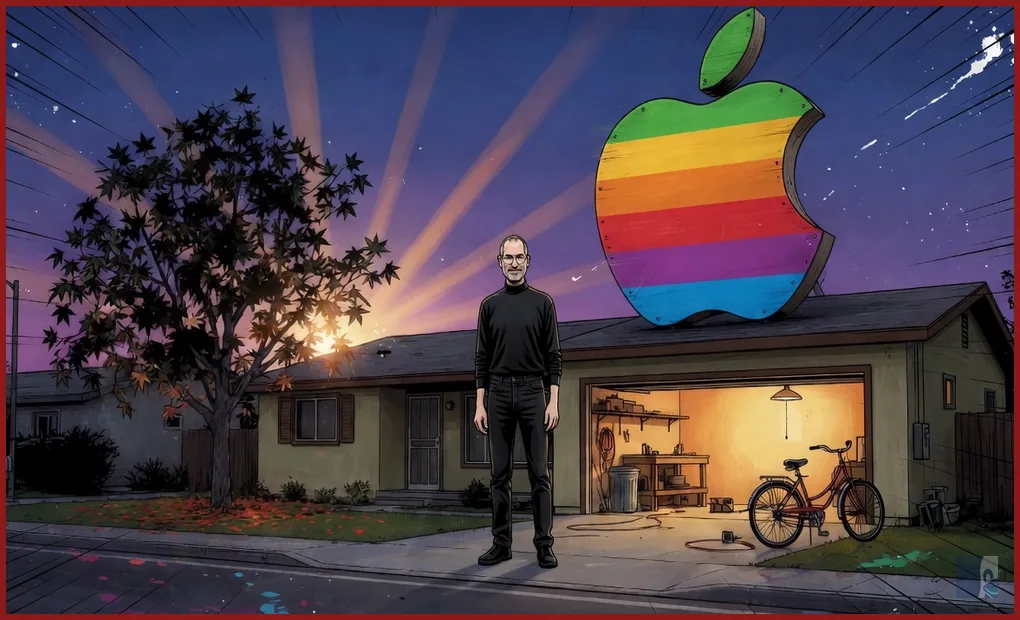
On 1º April 1976, three men signed the founding documents of a company in a Los Altos garage: Steven Paul Jobs, Stephen Gary Wozniak, and Ronald Wayne. Wayne, frightened by the risk, sold his 10% for US$ 800 just twelve days later — a stake that would be worth tens of billions. Thirty-five years later, on October 5, 2011, Jobs died in Palo Alto at 56, leaving behind the world's most valuable technology company. This is the story of the man who invented almost nothing — yet redefined everything he touched.
1955–1974: adoption, Homestead, and calligraphy
Jobs was born in San Francisco on February 24, 1955. His biological parents, Joanne Schieble and Abdulfattah Jandali (a Syrian who would become a university professor), gave the baby up for adoption. He was raised by Paul Jobs, a machinist, and Clara Hagopian, an accountant — a working-class family in Mountain View, at the heart of what would become Silicon Valley.
At Homestead High in Cupertino, around 1971, a mutual friend introduced him to Steve Wozniak, five years older and already obsessed with designing machines. In 1972, Jobs entered Reed College in Portland but dropped out in the first semester — although he continued auditing calligraphy classes. Years later, he would credit that curiosity with his refusal to accept ugly fonts on the Macintosh. Then came Atari (1974, designing games) and a trip to India that same year in search of a guru. He returned thin, with a shaved head and Zen in his baggage. Around this time, he and Wozniak built the Blue Box, an illegal device that cloned telephone carriers' tones to make free calls: Woz built, Jobs sold. The duo's pattern was already established.
1976–1984: the apple, Apple II, and Macintosh
Wozniak brought the Apple I to the Homebrew Computer Club to show his peers. Jobs saw a customer. Paul Terrell of the Byte Shop in Mountain View ordered 50 assembled boards at US$ 500 each; the pair sold a VW van and an HP calculator, bought parts on credit, and delivered. About 200 units were sold at US$ 666,66. Ronald Wayne, formerly of Atari, drew the first logo and bailed out. The story of the engineer behind the machines is in The history of Steve Wozniak.
The Apple II, introduced at the West Coast Computer Faire in June 1977, was the leap: color, BASIC in ROM, and expansion slots. Mike Markkula brought money and business discipline. The IPO on December 12, 1980 made Jobs, at 25, a multimillionaire. A visit to Xerox PARC in 1979 planted the seed: there were the Alto, the mouse, and windows. Lisa (1983) tried to bring that to market and was too expensive. It was the Macintosh, launched on January 24, 1984 with Ridley Scott's Super Bowl commercial, that put the graphical interface within ordinary people's reach. On screen, a single word: “Hello.”
1985–1996: the exit, the cube, and the toy
John Sculley, the executive Jobs had brought from Pepsi in 1983 with the famous line about “selling sugar water or changing the world,” turned the board against him. In May of 1985 Jobs lost control of the Macintosh and, on September 17, resigned from his own company. He took a handful of people with him and founded NeXT: beautiful, extremely expensive black workstations aimed at academia. The hardware sold poorly, but the software — NeXTSTEP, built on the Mach microkernel, with Display PostScript and Objective-C — would survive everything. Not by chance, Tim Berners-Lee wrote the first web browser on a NeXT.
In February of 1986, Jobs bought Lucasfilm's computer graphics division for US$ 10 million and named it Pixar. At first, it sold rendering hardware. Then came Toy Story, in 1995 — the first 100% CGI feature film — which transformed Pixar into a studio and Jobs into a billionaire at its IPO. Disney would buy Pixar in 2006, making Jobs its largest individual shareholder and a board member.
1996–2007: the return, the “i,” and the phone
Apple, floundering and without a modern operating system, bought NeXT on December 20, 1996 for around US$ 429 million — bringing Jobs back with it. He returned as an adviser, became interim CEO in 1997 and permanent CEO in 2000. He cut product lines, struck a survival deal with Microsoft (Bill Gates invested US$ 150 million), and launched the sequence that remade the company: iMac (1998), iPod (2001), iTunes Store (2003).
The climax came at Macworld on January 9, 2007: “an iPod, a phone, and an internet communicator.” They were not three devices — it was the iPhone. The App Store arrived in 2008, the iPad in 2010, and that year Apple surpassed Microsoft in market value. Beneath all this runs a legacy relevant to this blog's readers: Darwin, the open-source core Apple publishes, descends directly from Mach/NeXTSTEP; the engine WebKit was born from the KDE project's KHTML. Anyone compiling WebKit or playing with a hackintosh is unknowingly working with the black cube's legacy. The other side of that table — the system Apple never was — is covered in Linux turns 35 and in The history of UNIX.
2003–2011: cancer and “oh wow”
In 2003, doctors diagnosed a pancreatic neuroendocrine tumor — a rare, more treatable form, for which Jobs delayed surgery for months while trying alternative diets, a decision he would regret. He had surgery in 2004, took leave in 2009 for a liver transplant, and still took the stage to present the iPad 2 in March 2011 to an ovation. On August 24, 2011 he resigned as CEO and nominated Tim Cook: “I have always said that if the day came when I could no longer fulfill my duties, I would be the first to let you know. Unfortunately, that day has come.”
He died at home in Palo Alto on October 5, 2011, of cancer-related respiratory arrest, at 56. His sister, writer Mona Simpson, recounted his last words at the funeral: “OH WOW. OH WOW. OH WOW.” He was buried in an unmarked grave at Alta Mesa cemetery. In 2022, he posthumously received the Presidential Medal of Freedom. He left his wife Laurene Powell (married in 1991 in Yosemite) and children Reed, Erin, and Eve — as well as Lisa Brennan-Jobs, his daughter from his youth, whom he took years to acknowledge.
Timeline
- 24/Feb/1955 — Born in San Francisco; adopted by Paul and Clara Jobs
- 1971 — Meets Steve Wozniak at Homestead High
- 1972 — Enters and leaves Reed College (stays for calligraphy classes)
- 1974 — Atari and trip to India; Blue Box with Wozniak
- 1º/Apr/1976 — Apple founded; Wayne sells his 10% for US$ 800
- 1977 — Apple II at the West Coast Computer Faire
- 1979 — Visit to Xerox PARC (mouse, windows, GUI)
- 12/Dec/1980 — Apple IPO; Jobs a multimillionaire at 25
- 24/Jan/1984 — Macintosh launch
- 1985 — Loses internal power and leaves Apple; founds NeXT
- 1986 — Buys Pixar from Lucasfilm for US$ 10 million
- 1995 — Toy Story, first 100% CGI feature film
- 20/Dec/1996 — Apple buys NeXT; Jobs returns
- 1997–2000 — Interim then permanent CEO; Microsoft deal
- 1998–2003 — iMac, iPod, and iTunes Store
- 2003 — Pancreatic cancer diagnosis
- 9/Jan/2007 — iPhone announcement
- 2010 — iPad; Apple surpasses Microsoft in value
- 24/Aug/2011 — Resigns as CEO; nominates Tim Cook
- 5/Oct/2011 — Dies in Palo Alto at 56
Wrap-up
Jobs did not invent the personal computer, CGI animated film, digital music player, or smartphone. What he did was squeeze each of these things until they fit on a desk, in a pocket, in a child's hands — and turn good taste into business strategy. He treated ugliness as a character flaw. Wozniak assembled the circuit; Jobs made the world want it.
That is why this post's cover is the Los Altos garage at blue hour, not Cupertino's glass stage: the six-colored apple of 1977 on the ranch house roof, the man in a turtleneck on the sidewalk. Everything else — the iPhone in your pocket, the Mac on your desk — was a consequence of that garage.