
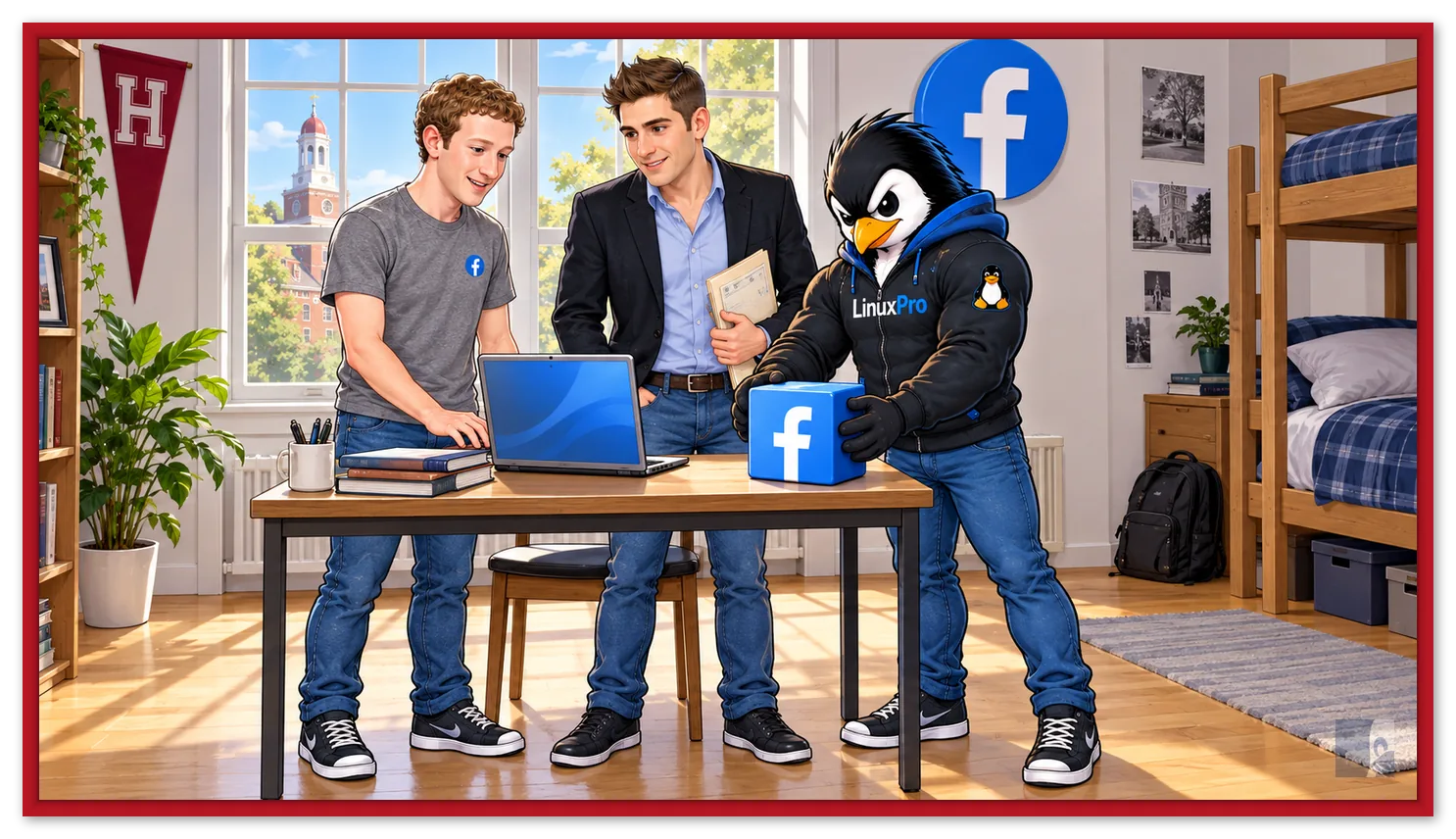
On 4 February 2004, Mark Elliot Zuckerberg launched TheFacebook.com from a room in Harvard's Kirkland House. Eduardo Luiz Saverin, a Brazilian from São Paulo, put up the first few thousand dollars and became CFO. Twenty-two years later, Meta is paying US$ 17 billion to 47 US states over harm to teenagers, the WhatsApp it bought has 3 billion users, and Saverin — owner of about 2% of the company, living in Singapore — is the island's richest man. This is the story of the two founders: the programmer the world knows and the Brazilian who paid for the first server.
Dobbs Ferry, Facemash, and the wrong lesson
Zuckerberg was born in White Plains, New York, on 14 May 1984 and grew up in Dobbs Ferry — the son of a dentist and a psychiatrist, the only boy among three sisters. He attended Phillips Exeter and entered Harvard in 2002, living in Kirkland House and studying psychology and computer science. On 28 October 2003 he launched Facemash: a website showing photos of two female students side by side to vote on who was more attractive, with images scraped from dormitory “facebooks”. Harvard brought internal proceedings against him and he apologized. The lesson he took, however, was not “do not do it” — it was “do it with a login”.
Around that time, twins Cameron and Tyler Winklevoss and Divya Narendra had a campus social-network project, HarvardConnection (later ConnectU), and invited Zuckerberg to program it. He accepted but kept stalling — and, on 4 February 2004, launched TheFacebook with Dustin Moskovitz, Chris Hughes, and Andrew McCollum. Saverin, of Eliot House, studied economics and had already made money from oil and a weather bet: he was the partner who understood checks. He put in about US$ 1.000 initially and somewhere between US$ 15 thousand and US$ 18 thousand in total, holding about 30% of the company on paper at its founding. The film The Social Network (2010) dramatizes the tone of the relationship; the emails that later surfaced do not.
Palo Alto, Sean Parker, and Saverin's dilution
The site expanded from Harvard to Stanford, Columbia, and Yale. In the summer of 2004, Zuckerberg moved to Palo Alto. Sean Parker, the creator of Napster, joined as president and opened Silicon Valley's doors. In May 2005 came Accel's check: US$ 12,7 million. Meanwhile, Saverin stayed in New York managing accounts and advertising — far from the company's center of gravity.
The breaking point came on 7 January 2005, when the company issued more than 9 million new shares to Zuckerberg, Moskovitz, and Parker. Without an anti-dilution clause in the contract, Saverin's stake plummeted — from about 24% to less than 10%, and by the most aggressive calculations to nearly zero. He sued. In emails that Business Insider published in 2012, Zuckerberg even talked about “screwing” his partner, to which the company lawyer responded with a warning: that was a breach of fiduciary duty. The settlement, reached in 2009, is confidential; it is known that his cofounder title was restored and Saverin's stake was around 4% to 5% at the time (today documents indicate about 2% of Meta). The Winklevoss twins and Narendra had settled in 2008 for about US$ 65 million in cash and stock. The film made Saverin the face of betrayal; the bank statement made him a billionaire.
IPO, Instagram, and the engineering behind them
Facebook reached 1 billion users in 2012. The IPO on 18 May 2012, at US$ 38 per share and a valuation of about US$ 104 billion, was the largest technology IPO of its time — and a fiasco on its first trading day. That same year came Instagram (April 2012, US$ 1 billion, from Kevin Systrom) and, in February 2014, WhatsApp for about US$ 19,3 billion — whose story you can find in The history of Jan Koum.
Beneath the product is an engineering story of interest to this blog's readers. Facebook began in PHP, then created HipHop (which compiled PHP to C++), then HHVM (the virtual machine we covered again in the post Installing HHVM on Ubuntu) and finally the language Hack. It also gave us React, GraphQL, Cassandra, and Open Compute Project — the servers Facebook designed and opened to the industry. The engineering that fit in a dorm room in 2004 became one of the largest deployments of PHP on the planet — and it was precisely that weight that brought HHVM into existence.
Cambridge Analytica, Meta, and the 2026 settlement
The shift in its image began in 2016, with fake news and Russian interference in the US election. In 2018 the Cambridge Analytica scandal broke — 87 million profiles used without consent — sending Zuckerberg to testify before Congress and triggering the #DeleteFacebook campaign, led by Brian Acton, WhatsApp's other cofounder. On 28 October 2021, the company became Meta Platforms, betting on the metaverse and headsets — and accumulating billions in losses at Reality Labs. Then came Threads (2023), the open model Llama (as open as Meta is willing to release) in the war against OpenAI, and Reels in the contest against TikTok.
In August 2026, Meta reached a settlement with 47 states, the District of Columbia, and territories worth roughly US$ 17 billion over addiction and harm to children and teenagers: a two-hour limit for minors, age verification, hidden like counts, a break reminder every 15 minutes, and a research foundation. The company admitted no wrongdoing. The Facemash boy became the attention economy's permanent defendant.
Saverin: Singapore, B Capital, and Liverpool
Eduardo Luiz Saverin was born in São Paulo on 19 March 1982 into a Jewish family that passed through Rio de Janeiro before emigrating to Miami. He graduated in economics from Harvard. In 2011 he renounced US citizenship and settled in Singapore — which does not tax capital gains — weeks before Facebook's IPO. The press spoke of tax savings; he claimed he had simply moved there. He married Elaine Andriejanssen in 2015 and, that same year, founded B Capital with Raj Ganguly, now managing tens of billions of dollars.
According to Forbes Asia (September 2026), Saverin is Singapore's richest man for the fourth consecutive year, with US$ 32,9 billion — even after losing US$ 10,1 billion during the year as Meta fell 25%. In 2026 he joined the 1892 Holdings consortium, which bought 38% of Liverpool. The Brazilian whom the film portrayed as the story's fool is now the silent owner of part of Facebook and an English club. He almost never gives interviews — unlike his partner.
Timeline
- 19/mar/1982 — Eduardo Saverin is born in São Paulo
- 14/mai/1984 — Mark Zuckerberg is born in White Plains (NY)
- 28/out/2003 — Facemash goes offline after controversy at Harvard
- 4/fev/2004 — TheFacebook launches
- 2004 — Move to Palo Alto; Sean Parker joins
- jan/2005 — Share issuance dilutes Saverin's stake; the dispute begins
- mai/2005 — Accel investment (US$ 12,7 million)
- 2008 — Settlement with Winklevoss/Narendra (~US$ 65 million)
- 2009 — Confidential settlement with Saverin restores cofounder title
- 2011 — Saverin renounces US citizenship and moves to Singapore
- abr/2012 — Instagram acquisition (US$ 1 billion)
- 18/mai/2012 — Facebook IPO (~US$ 104 billion)
- fev/2014 — WhatsApp acquisition (~US$ 19,3 billion)
- 2018 — Cambridge Analytica scandal; Zuckerberg in Congress
- 28/out/2021 — Facebook, Inc. becomes Meta Platforms
- ago/2026 — Settlement of ~US$ 17 billion with 47 states
Wrap-up
Two college students, a photo website, a thousand-dollar check, and a lawsuit. Facebook connected 3 billion people and sold the social graph to advertisers. Zuckerberg never relinquished control — super-voting shares, CEO and chairman roles. Saverin left the building and kept the stock. The Winklevoss twins used their settlement to buy Bitcoin. The Kirkland dormitory on the cover is still brick and snow; the blue cube in the courtyard is what came out of that room.
The story belongs to both of them. The name the world repeats is the programmer's. The name on the Singapore bank statement is the Brazilian's, the one who paid for the first server.
Cover illustration drawn from photographs available on Wikimedia Commons: Mark Zuckerberg (CC BY 2.0) and Eduardo Saverin (CC BY-SA 3.0).

